Revolting! by Mick Hume
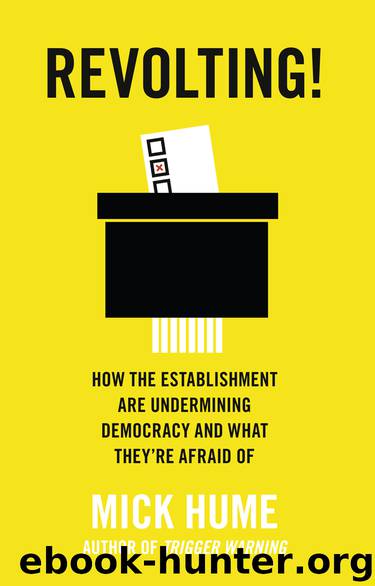
Author:Mick Hume
Language: eng
Format: epub
Publisher: HarperCollins Publishers
Published: 2017-01-13T05:00:00+00:00
Revolution – but not ‘mob rule’
After its 2,000-year slumber, democracy was to be truly reawakened in explosive style by the American and French revolutions of the late eighteenth century. Yet even amidst those tumults, fear and contempt towards ‘the mob or mere dregs of the people’ was much in evidence.
In 1776 the Founding Fathers of the United States had declared the equality of all men in order to mobilise and justify their revolutionary war of independence against the British colonialists. Yet most of these future US presidents were not really committed democrats, instead displaying an unbridled passion for a strictly bridled form of democracy. They favoured the order of ancient republican Rome over the turbulence of democratic Athens, and accordingly named their government institutions – Senate, Capitol – after the Roman bodies.
In his contributions to The Federalist Papers James Madison, later the fourth US president, advanced some of the key arguments over the shape of the new American government. Madison was keen to draw a line between the American republic and those ‘turbulent democracies of Ancient Greece and modern Italy’. The problem with popular assemblies, he insisted, was that the passion of the irrational masses would inevitably drown out the reason of wise men. Even if every Athenian citizen had been a Socrates, Madison maintained, ‘every Athenian assembly would still have been a mob’.20
This was why Madison argued for an upper house, the Senate, to be less democratic and empowered to protect people from their own worst instincts, whenever they were ‘stimulated by some irregular passion’ ‘or misled by the artful misrepresentations of interested men’ to ‘call for measures which they themselves will afterwards be the most ready to lament and condemn’. The powerful Supreme Court and the electoral college would be other arms of the system of constitutional ‘checks and balances’ to keep the ‘irregular passions’ of the populace in check.
Madison’s case against potential mob rule won the day, and the US Senate was established as a conservative bulwark against too much democracy in the lower house of Congress. (The allocation of two Senate seats to each US state regardless of its population, for example, being intended to help the smaller rural and generally more conservative states counter the popular influence of the big urban centres.) It seems that those anti-democrats who have argued for the wise unelected men and women of the House of Lords to protect the British people from their own irregular passions by reversing the Brexit referendum vote have some auspicious forebears.
Others among the Founding Fathers were even more adamant that America would be a republic, but not a popular democracy. John Adams, the second US president, was horrified by any notion of majority rule, which he saw as a mortal threat to the all-important property rights of America’s new ruling class. Adams predicted it would mean ‘The idle, the vicious, the intemperate would rush into the utmost extravagance of debauchery’ at the expense of the propertied minority, with the result that ‘anarchy and tyranny commence’.
Download
This site does not store any files on its server. We only index and link to content provided by other sites. Please contact the content providers to delete copyright contents if any and email us, we'll remove relevant links or contents immediately.
| Anthropology | Archaeology |
| Philosophy | Politics & Government |
| Social Sciences | Sociology |
| Women's Studies |
The Secret History by Donna Tartt(19479)
The Social Justice Warrior Handbook by Lisa De Pasquale(12297)
Thirteen Reasons Why by Jay Asher(9134)
This Is How You Lose Her by Junot Diaz(7061)
Weapons of Math Destruction by Cathy O'Neil(6484)
Zero to One by Peter Thiel(5955)
Beartown by Fredrik Backman(5951)
The Myth of the Strong Leader by Archie Brown(5632)
The Fire Next Time by James Baldwin(5592)
How Democracies Die by Steven Levitsky & Daniel Ziblatt(5335)
Promise Me, Dad by Joe Biden(5238)
Stone's Rules by Roger Stone(5196)
A Higher Loyalty: Truth, Lies, and Leadership by James Comey(5092)
100 Deadly Skills by Clint Emerson(5032)
Rise and Kill First by Ronen Bergman(4908)
Secrecy World by Jake Bernstein(4894)
The David Icke Guide to the Global Conspiracy (and how to end it) by David Icke(4854)
The Doomsday Machine by Daniel Ellsberg(4631)
The Farm by Tom Rob Smith(4614)
